
Spotlight on STNR
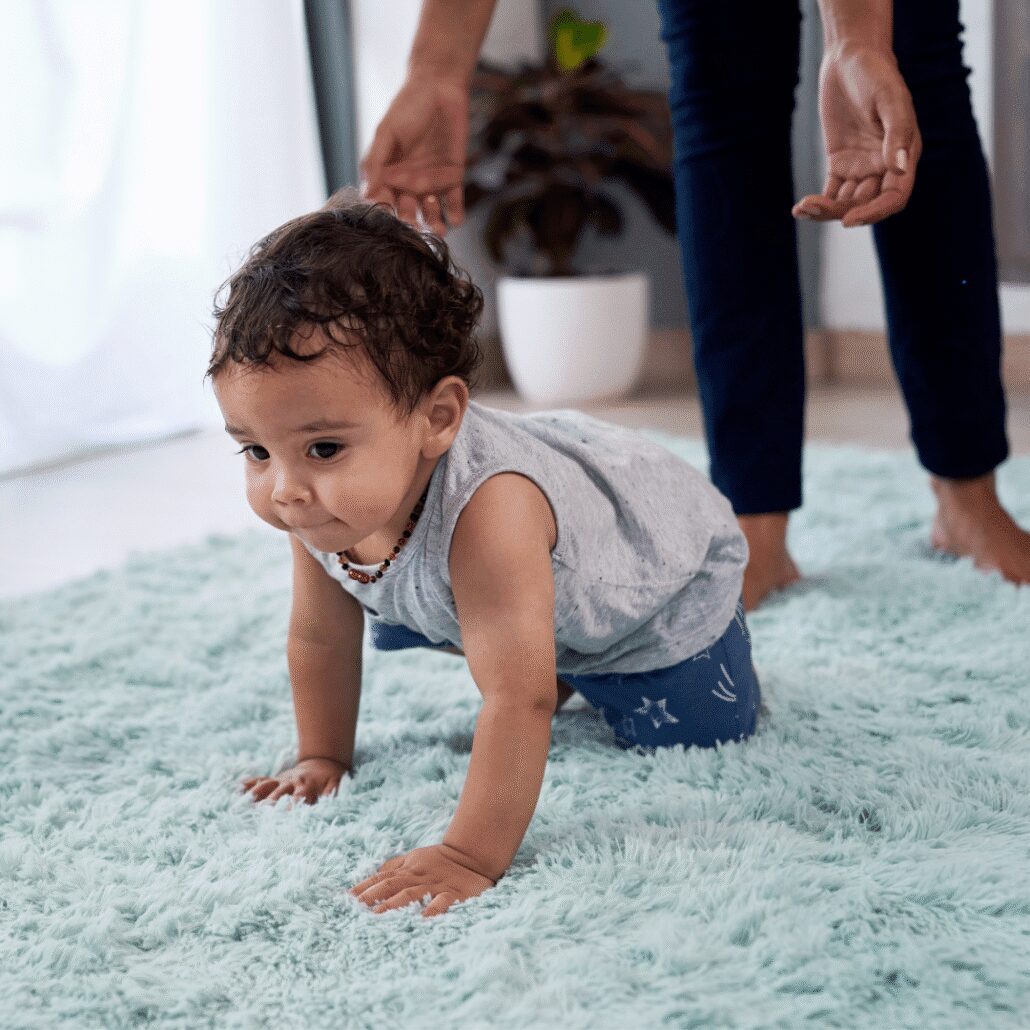
STNR is a transitional reflex that builds upon several key movements that provide an infant stability and spatial awareness. This is a four-point reflex, where the uppers and lowers are learning to coordinate first with head movements and then independent of head movement while in quadruped.
Rocking back and forth, the reflex motion is activated by two distinct head movements. When an infant’s head bends down, the upper body flexes and the lower extends. When the head tilts back up, the upper body extends while the lower flexes. The movement builds upon several reflex integrations, including Moro, TLR and Landau for the forward-back and up-down understanding. With Spinal Galant and ATNR, an infant gains an understanding of side-to-side motion. Overall, it’s with STNR that the body’s full dimension and movement in space come together.
Integration of STNR allows an understanding that the head can move independent of the body. The spinal curvature is impacted as well through this reflex movement, including the cervical, thoracic and lumbar portions of the spine. When STNR remains active, postural stability, poor muscle tone and balance may result. Spinal instability may manifest in a child unable to sit still, or alternatively the tendency to hold a stiff, hunched over posture.
STNR’s reciprocal rocking movement sets an infant up for crawling, a critical milestone for both physical and neurological development. When this reflex remains immature, and crawling movement is bypassed, we tend to see an impact on the connections between the brain’s hemispheres. This may result in behavioral challenges, including but not limited to a lack of initiative or follow-through and weakened executive functioning in areas like problem solving. Additionally, an active STNR may result in poor hand-eye coordination, near-far point vision and skills requiring upper and lower body coordination. Most people with reading, writing and learning challenge tend to have active STNR.
Since so many preceding reflexes need to be integrated to propel the emergence of the STNR movements, this is the reflex most likely to remain active to some degree in many adults.

