
Spotlight on ATNR
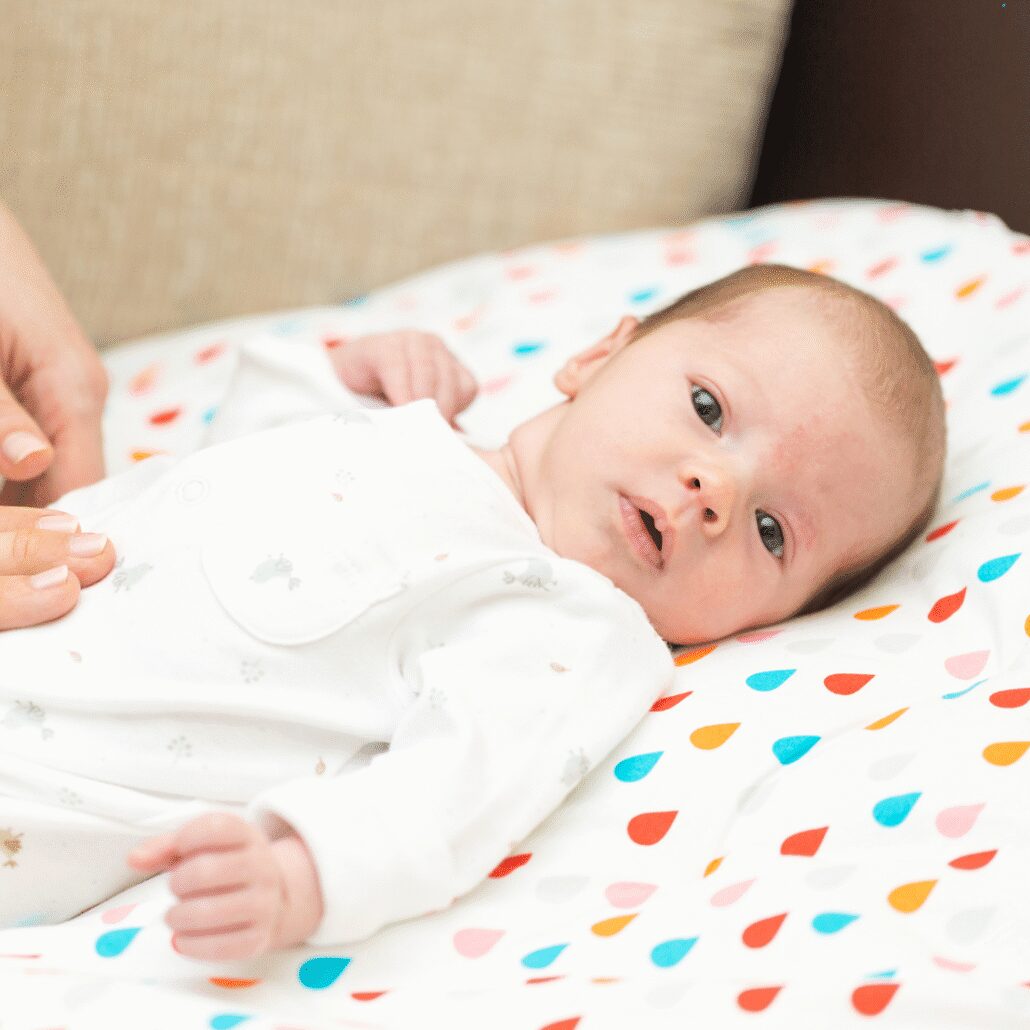
In utero, the Asymmetrical Tonic Neck Reflex (ATNR) reflex emerges with the head turning to one side and the limbs on the same side opening with extension. The opposing side of the body responds with flexion.
The movement reinforces muscle tone and assists with baby’s safe passage down the birth canal. As an infant breastfeeds, she is working to further integrate this primitive movement as the head turns toward the mother, hands grasping for her clothing or hair, feet kneading into the mothers abdomen. This angle, notably, is very different than the more passive positioning of bottle feeding.
The ATNR reflex helps establish our understanding of the midline and its role in supporting our balance. The one-sided nature of the reflex movement underscores the distinction between right and left and the body’s two unique hemispheres. As an infant explores the world, larger cross-lateral movements from the limbs become refined to smaller, fine motor movements with the hands and feet. You will see the start of this as babies learn to move food and objects from hand to mouth, first with palming then with pinching.
This development also extends to visual processing, where the two eyes learn to work in tandem and eventually without the movement of the head. If ATNR remains immature, children often face challenges in the classroom with reading and writing. A child might angle their work to accommodate visual imbalance or struggle moving their head back and forth while reading. Speech and language are also impacted by ATNR, and articulation struggles often emerge with an immature reflex. As lateralization of the body extends too to the tongue and as large movements become more refined, ATNR supports the tongue’s movement inside the mouth supports breastfeeding as well as language development.
Since ATNR supports cross-lateral movement, an immature reflex may hinder a strong sense of balance in space. Infants may not reach or may even bypass critical developmental milestones like crawling. Riding a bicycle, an activity that requires both balance and reciprocal motion may prove challenging. Driving a vehicle may be similarly more difficult, as it relies on visual tracking side to side while the other half of the body remains in place.
The vestibular system is supported by ATNR, as the reflex supports rotational movements that signal from the inner ear to the brain. Motion sickness therefore may occur with activities that call upon fully integrated ATNR like spinning.

