The Value of Hands-On Learning
Recently, I was listening to a Huberman Labs podcast featuring special guest Dr. Terry Sejnowski, who has pioneered the field of computational neuroscience and learning models. The discussion, which turned to training AI with reinforcement and repetition, touched on the valuable difference between cognitive and procedural learning. Simply put, theory and fact need to be put into physical practice to solidify learning development.
Cognitive learning, which takes place in our brain’s cortical system, is what we think of as book learning. It’s the consumption and memorization of facts, step by step. Below our cortex, at the basal ganglia, procedural learning takes place. By engaging the entire body and sensory system, learning is unlocked in a meaningful way. This is learning by doing, where the brain is actively engaged in repetition and reinforcement with growing precision. Consider golfing, a sport my sons love. With practice, the muscle memory and motor learning are refined. They feel when the swing is a good one.
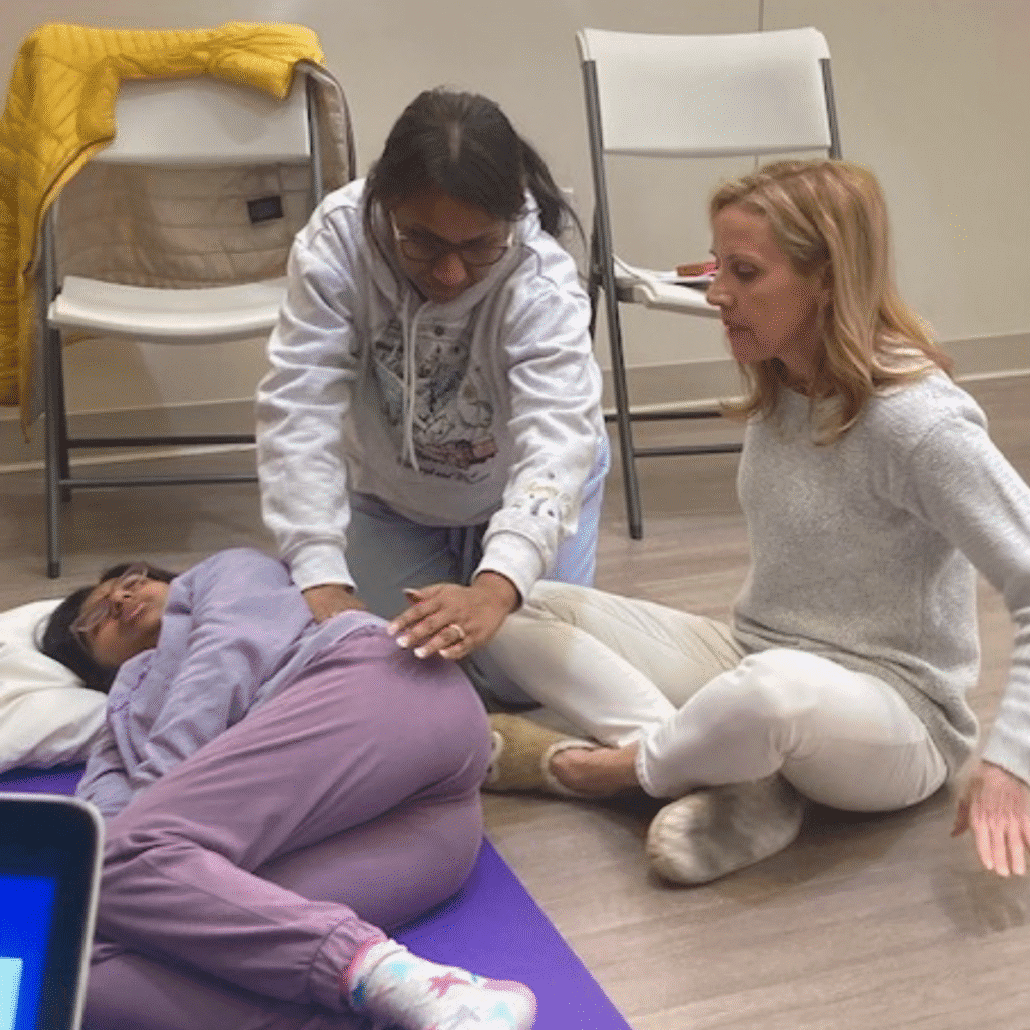
In Thrive Therapy’s workshops, we compliment the discussion of RMTi in our textbooks with hands-on demonstration. For caretakers, this is a particularly powerful part of class. The opportunity to feel movement in your body and to demonstrate an exercise in a partner’s body brings rhythmic movement therapy to life. With practice, we feel our body’s limitations and are primed to understand the signs of fatigue in others. The mother of a client once shared this with me:
“My husband and I took a workshop together, and after this, we had SUCH a better idea of what we were doing for our children, what movements felt like when they were effective and when they were not, when it was too much, and WHY it worked for our kids. It was a complete eye-opener for us, and allowed us to do the exercises at home with SO much more confidence and effectiveness.”

