
Root and Suck

The words seem stuck somewhere in the back of her throat, stammering and stuttering as she tries to express herself. His pen cap is crushed, the result of constant absent-minded chewing in the classroom. She soothes herself to sleep with her thumb in her mouth. Overeating patterns, smoking or vaping addictions and other oral fixations are the sign of immature reflexes. Both stimulation seeking and sensitivity in the mouth region is closely associated with grasping reflexes present immediate at birth.

Grasping reflexes originate in utero but peak at birth and play a role in the integration of the second stage of Moro. Infants begin to explore their world with their mouths and hands, responding to stimuli with curling or grasping movements, or with their mouths turning and sucking.

Our Root reflex is present as newborns seek nourishment in an unfamiliar environment. The mother’s breastmilk is a smell that is familiar and grounding to an infant, guiding their movement. When the corner of an infant’s mouth is stimulated, her head turns to the source as her mouth opens. This reflex plays an important role in locating food and is most active in those critical moments after birth. The complimentary reflex, Suck, works in conjunction with the Rooting reflex to obtain that nourishment. When the middle of the top lip is stimulated, the infant seeks to attach to a nipple, pushing her tongue upwards and sucking while breath and swallowing simultaneously.

We frequently speak about the importance of immediate bonding with the mother following delivery and those critical moments when breastfeeding releases the feeling of safety for an infant in a new environment. By feeding and embrace, we’re moving successfully through the stages of Moro from high alert fling to comfort, cling and grasping to the mother’s chest and nipple.

Retained Root/Suck reflexes may contribute to long-term speech and articulation difficulties as well as more complex challenges with connections to others. An active rooting reflex may result in hypersensitivity to touch on the face, while an active suck reflex may result in close talkers and the failure to maintain boundaries in terms of personal space.

Retained Root/Suck reflexes may contribute to long-term speech and articulation difficulties as well as more complex challenges with connections to others. An active rooting reflex may result in hypersensitivity to touch on the face, while an active suck reflex may result in close talkers and the failure to maintain boundaries in terms of personal space.

MORO

Imagine hearing the inescapable tick of a clock, or voices from the next table so distracting you cannot focus on your meal. Your senses are on high alert. Loud noises and bright lights are exhausting and changes in a routine may feel unbearable. Without relief, an overstimulated system is poised for action at all times, with anxiety and stress manifesting in sudden uncontrollable outbursts or difficulty falling and staying asleep. The body struggles to downshift and relax, which can even lead to physical ailments from digestive issues to infections and motion sickness. 

When Moro is not fully integrated, the body is unable to filter and process sensory information. This may include stimuli coming from one or multiple sensory systems: vestibular, tactile, proprioceptive, visual, auditory and interoceptive.

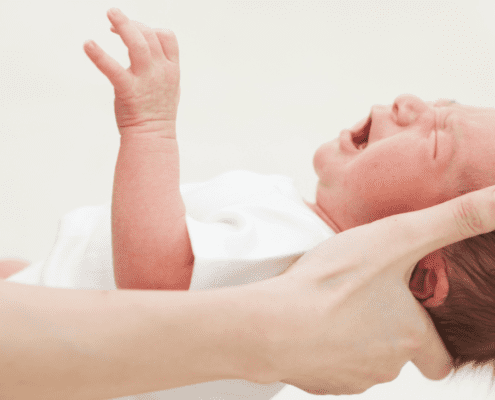
As an essential defensive reflex, the development of Moro contributes to our ability to safely explore our world independently, identifying true danger. Imagine an infant lying alone in a basinet, waking suddenly to a loud sound. Without its swaddle, the baby cries out, reaching his arms and legs upwards out into the air seeking safety. 

The first stage of Moro emerges in utero but peaks at birth when the infant inhales its first breath in an entirely unknown environment. Most likely, its limbs are flailing as it lets out a cry for help. This stage is the instantaneous activation of the baby’s survival system and a release of cortisol and noradrenaline signals what we refer to as the ‘fight or flight response’. 

In response to stimuli, the reflex begins with an initial movement away from the midline, hands reaching outward. With the second stage, a clinging movement initiates, where the body pulls inward to the center, hands grasp closed and the baby exhales. An infant is naturally seeking a caretaker’s touch, to be hugged, rocked and soothed. With cling comes the downshifting of those fight or flight reactions, a steadying of the heart rate and a relaxing of breath as well as the digestive system. The two stages of Moro might be viewed as complimentary reflexes, like breathing in (first stage) and out (second stage).

Collectively, the Moro reflex integrates between 2 and 4 months of age. If Moro stays active in its first stage, the more mature development of the adult ‘startle’ reflex, known as the ‘Strauss reflex,’ cannot establish itself and the body will continue to struggle with effectively defining real from perceived danger. Through integration, the body is able to process and respond with a higher awareness rather than simply reacting. 

Moro as a reflex is often referred to as the gateway reflex, enabling the effective integration of several other key developmental reflexes. Practicing the cling, or calming movements of early infancy may help the body to react and regulate against stressors in the environment.

Fear Paralysis

A panic attack before a new meeting, the desire to hole up in one’s room or shy away from social engagements, fear of embarrassment, failure or separation, anxiety and extreme sensitivity to touch are all manifestations of a delayed integrated fear paralysis reflex. 

When FPR, or the withdrawal reflex, remains strong and prominent, we may react with a version of immobility and isolation. For some, a need to control the environment results in disordered eating, perfectionism and a strong desire for predictable, structured routine. Addressing the challenges of overactive FPR involve mimicking the pre-birth movements in utero, where a fetus tests safety within a water environment. 

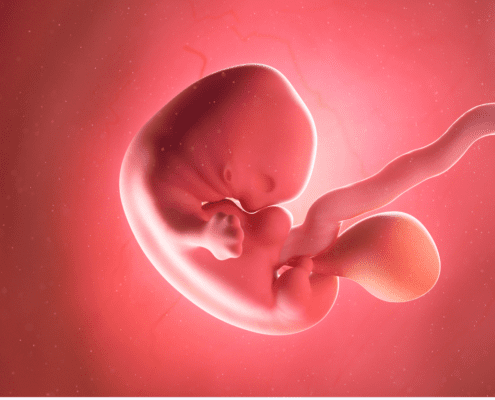
Fear paralysis emerges as the first defensive reflex, as early as five weeks and integrates in utero between nine and thirty-two weeks. Known as the withdrawal reflex, fear paralysis involves an instinctual shutdown, or freeze, when stressors in both the internal or external environment are detected. In evolutionary terms, the animal instinct is reptilian, and you might imagine a stunned animal who is frozen and on high alert for predators after hearing a sudden sound. Some animals faint or play dead as a total protective shutdown. For mammals, we continue to develop the ability to assess and mobilize away from stressors. The reflex creates the foundation for learning to navigate with perceived safety.

Our body builds feelings of safety in conjunction with the Automatic Nervous System (ANS), which consists of the parasympathetic and the sympathetic parts that balance calm with alertness. Within the parasympathetic nervous system, the dorsal vagal nerve is the part that relates to FPR, responsible for reactions that lower the heart rate, breathing and relaxing the bowels to release waste. This is also the system responsible for the ability of animals to ‘play dead.’

If stressors, either from the outside environment or from the mother, are substantial, the FPR may not effectively develop and integrate within the body. It results in challenges throughout our lives related to fear. Addressing those challenges of immobilization, we can use reflex integration to bring the body back to its earliest movements, in a watery pre-birth environment.