A Reflex Review

Defensive Reflexes: 

Fear Paralysis (FP):  Fear paralysis, known as the withdrawal reflex, involves an automatic shutdown, or freeze, when stressors in both the internal or external environment are detected. Immaturities may lead to challenges with latching while breastfeeding, reflux, separation anxiety, school refusal, social anxiety, shyness, panic attacks, sensitivity to food textures, eating disorders and perfectionism.

Moro: The Moro reflex, which is divided into the ‘fling’ and the ‘cling’ movements, leads us to develop self-regulation and a feeling of safety while navigating our environment. Immaturities may lead someone to have challenges with sensory processing, be easily distracted or overstimulated, have uncontrollable emotional outbursts, be easily distracted or overstimulated by environmental input, experience difficulty falling or staying asleep, and have physical issues related to digestion and motion sickness.

Grasping Reflexes: 

Root and Suck: These complimentary reflexes play an important role in seeking of both nourishment and a safe, calm attachment. Immaturities may cause oral fixations like overeating, vaping, chewing objects like pens and thumb sucking. Speech and articulation issues like stuttering may also occur. Challenges with same age peer relationships due to lacking understanding of negotiation.

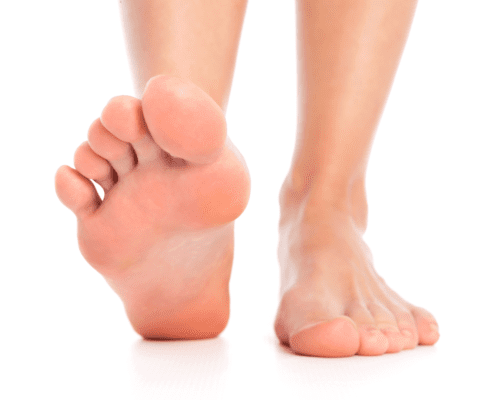
Infant Plantar: This reflex teaches the toes to flex and curl, allowing the development of more complex gross motor movement. If immature, the reflex may result in toe-walking, stiff shins or legs, as well as challenges with crawling that ultimately impact balance in walking and running.

Palmar Grasp: In terms of evolution, this reflex helps mammals learn to cling to their mother early in life, and for humans, we see this grasping reflex closely aligned to a sense of safety. Immaturities may cause pain or difficulty executing fine motor tasks like writing, as well as feelings of insecurity or awkward behavior in social interactions. Often, unpredictable events and changes in routine are harder to navigate.

Releasing Reflexes:

Babkin: As an important step in bonding, Babkin lays the groundwork for feelings of trust and healthy attachment in future relationships. An immature reflex may show up in tongue thrusting when writing or in moments of concentration, excessive drooling, oral fixations, as well as attachment issues that manifest in clinginess or hoarding behavior. 

Babinski: While this reflex is often associated with postural stability from the feet, the fascial chain that connects our musculature from the toes to the tongue underscores how both gross motor abilities and speech are influenced at once.  Delayed development of the reflex results in poor balance and motor planning, as well as a tendency to trip or fall. Speech and articulation issues may also emerge with an immature reflex. 

Whole Body Reflexes:

TLR: This reflex helps to develop appropriate muscle tone with the flexor and extensor muscles throughout the body. It helps to establish the vestibular system necessary for balance and coordination. Immaturities may show in low muscle tone, a stiff or weakened neck, hunched posture and difficulty executing prolonged physical activity. It may also show as dominant extensor muscles, toe-walking or navigation in stiff, jerky movements. Related to the visual and vestibular system input, struggles with depth perception, fear of heights and motion sickness may result.

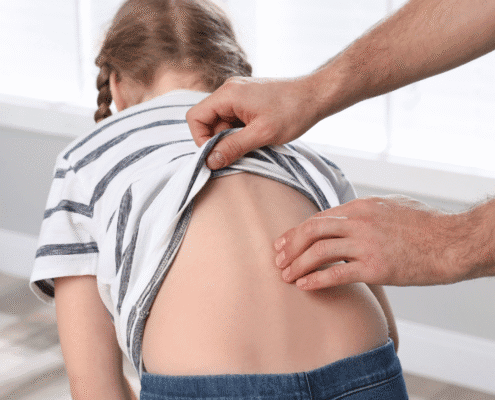
Spinal Galant: This reflex supports our ability to laterally flex our spine, and since the spine is a primitive sound conductor, auditory development is impacted with the emergence of this reflex. Immaturities may result in low muscle tone, scoliosis, back problems and postural issues, restlessness and trouble focusing. Related to the location of this reflex along the lumbar spine, auditory processing may be impacted, as well as challenges with bladder control like bedwetting and incontinence. 

ATNR: The emergence of this reflex supports a sense of balance through the midline and an understanding of the distinct right and left hemispheres of the body.  An immature reflex impacts balance, posture and coordination, particularly with difficulty in cross-lateral tasks like tying shoes. Visual tracking may be difficult and impact reading and writing, and the vestibular system may be impacted, especially with motion sickness with spinning movements. 

Landau:  This transitional reflex supports coordination between upper and lower body, strengthens muscle tone and reinforces the symbolic ability to take initiative, retain memory and focus.  Immaturities result in difficulty with movements that require full body coordination like swimming, poor posture, as well as hesitancy in social interactions and challenges with self-initiative. Prefrontal cortex-fueled executive functions may suffer, including challenges with focus and memory.

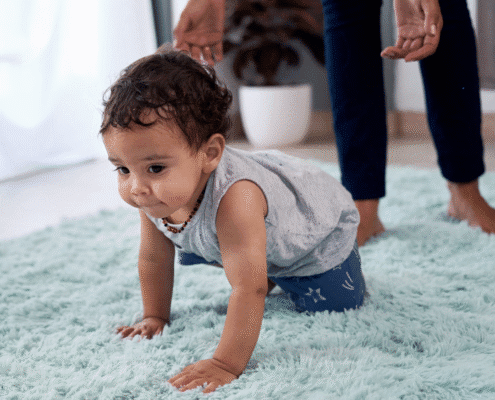
STNR: STNR is the reflex that allows the body to get into a four-point position in preparation for crawling.  An immature reflex may result in an infant skipping over the crawling stage. Poor postural stability, slumping and weak muscle tone may result. Near and far point visual processing challenges, that impact reading and writing, as well as challenges with hand-eye coordination may emerge.

Amphibian: This lifelong postural reflex emerges once several earlier reflexes are established and we gain an understanding of the independence of our upper and lower body movement with efficiency and coordination. Immaturities may manifest as clumsiness, muscle pain, stiff labored gait patterns and challenges in gross motor movement like running, jumping and coordinated athletic activities.

Amphibian Reflex

Our Amphibian reflex is a lifelong postural reflex, which essentially means that the movement pattern continues to remain active into adulthood. As an infant, this reflex follows on the emergence and development of the ATNR and Spinal Galant reflexes, typically around 4 to 6 months. 

This reflex begins with a stimulus when the hip flexes, with the knee bending on the same side of the body. Coordinated movement between the hips and knees appears both in prone and supine positions, seen when an infant grabs their feet in happy baby or commando, or army crawls before learning to push up on all-fours. The reflex plays a critical role in building upon our understanding of upper and lower body, and with development helps the hip and knees to function independently.

Amphibian is part of a whole-body movement system that contributes to our lifelong gross motor skills, helping us to walk, climb stairs and develop an efficient gait. The reflex supports upright posture, balance and stabilization as an infant continues to develop, moving from all-fours to standing on two legs. 

The Amphibian reflex is reliant on the emergence and integration of several primitive reflexes that establish a sense of our body’s two hemispheres, allowing us to gain further control of our movement as we explore the world around us. As such, immature reflexes preceding this reflex often result in an underdeveloped or sometimes absent Amphibian reflex. This may appear as stiff legs, tense or hypertonic movement and increased clumsiness. 

STNR

STNR is a transitional reflex that builds upon several key movements that provide an infant stability and spatial awareness. This is a four-point reflex, where the uppers and lowers are learning to coordinate first with head movements and then independent of head movement while in quadruped.

Rocking back and forth, the reflex motion is activated by two distinct head movements. When an infant’s head bends down, the upper body flexes and the lower extends. When the head tilts back up, the upper body extends while the lower flexes. The movement builds upon several reflex integrations, including Moro, TLR and Landau for the forward-back and up-down understanding. With Spinal Galant and ATNR, an infant gains an understanding of side-to-side motion. Overall, it’s with STNR that the body’s full dimension and movement in space come together. 

Integration of STNR allows an understanding that the head can move independent of the body. The spinal curvature is impacted as well through this reflex movement, including the cervical, thoracic and lumbar portions of the spine. When STNR remains active, postural stability, poor muscle tone and balance may result. Spinal instability may manifest in a child unable to sit still, or alternatively the tendency to hold a stiff, hunched over posture.

STNR’s reciprocal rocking movement sets an infant up for crawling, a critical milestone for both physical and neurological development. When this reflex remains immature, and crawling movement is bypassed, we tend to see an impact on the connections between the brain’s hemispheres. This may result in behavioral challenges, including but not limited to a lack of initiative or follow-through and weakened executive functioning in areas like problem solving. Additionally, an active STNR may result in poor hand-eye coordination, near-far point vision and skills requiring upper and lower body coordination. Most people with reading, writing and learning challenge tend to have active STNR. 

Since so many preceding reflexes need to be integrated to propel the emergence of the STNR movements, this is the reflex most likely to remain active to some degree in many adults.

Landau Reflex

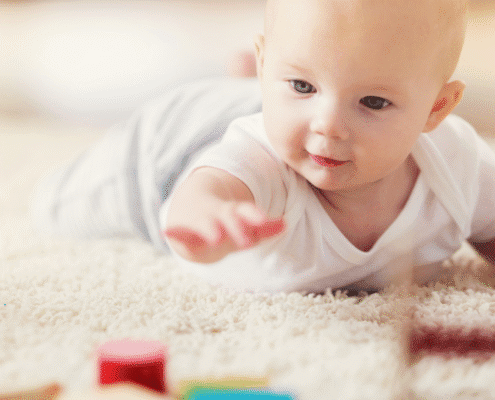
Landau is an important transitional reflex that touches on multiple developmental domains including posture, movement and information processing. As TLR begins to integrate, and as Moro matures, Landau emerges after birth. The movement, which together tends to mimic a Superman position or a skydiver in flight, initiates when an infant is in the prone position. Whether on his belly or held in a horizonal position under the belly, an infant’s chest and head lifts. Usually, legs, arms or both will lift and extend. There is a feeling of joy and safety in exploration. 

The reflex involves the full body, serving to establish connections between upper and lower halves. The stretching or extension of the limbs supports self-initiation, reaching outward with the potential to then bring things in. The head extends, increasing blood flow to the brain and specifically the prefrontal cortex.

The stimulation and connections established within the neocortex and the prefrontal cortex help establish the brain’s ability to be focused and attend. If the Landau reflex remains immature, memory retention and organizational abilities may suffer. Without a strong sense of self-motivation and initiative, an immature reflex may manifest in procrastination and a general lack of confidence in decision making. 

Physically, Landau continues the important postural journey, establishing control over all parts of the body as they navigate in tandem. An active Landau reflex may result in clumsy or stiff movements and lack of coordination. Tense postures and toe-walking may also be linked to reflex immaturities. As Landau emerges and the head lifts upward, a new perspective is established as an infant. The development supports three-dimensional vision, as well as the overall binocular vision and binaural hearing. 

ATNR

In utero, the Asymmetrical Tonic Neck Reflex (ATNR) reflex emerges with the head turning to one side and the limbs on the same side opening with extension. The opposing side of the body responds with flexion. 

The movement reinforces muscle tone and assists with baby’s safe passage down the birth canal. As an infant breastfeeds, she is working to further integrate this primitive movement as the head turns toward the mother, hands grasping for her clothing or hair, feet kneading into the mothers abdomen. This angle, notably, is very different than the more passive positioning of bottle feeding.

The ATNR reflex helps establish our understanding of the midline and its role in supporting our balance. The one-sided nature of the reflex movement underscores the distinction between right and left and the body’s two unique hemispheres. As an infant explores the world, larger cross-lateral movements from the limbs become refined to smaller, fine motor movements with the hands and feet. You will see the start of this as babies learn to move food and objects from hand to mouth, first with palming then with pinching.

This development also extends to visual processing, where the two eyes learn to work in tandem and eventually without the movement of the head. If ATNR remains immature, children often face challenges in the classroom with reading and writing. A child might angle their work to accommodate visual imbalance or struggle moving their head back and forth while reading. Speech and language are also impacted by ATNR, and articulation struggles often emerge with an immature reflex. As lateralization of the body extends too to the tongue and as large movements become more refined, ATNR supports the tongue’s movement inside the mouth supports breastfeeding as well as language development.

Since ATNR supports cross-lateral movement, an immature reflex may hinder a strong sense of balance in space. Infants may not reach or may even bypass critical developmental milestones like crawling. Riding a bicycle, an activity that requires both balance and reciprocal motion may prove challenging. Driving a vehicle may be similarly more difficult, as it relies on visual tracking side to side while the other half of the body remains in place. 

The vestibular system is supported by ATNR, as the reflex supports rotational movements that signal from the inner ear to the brain. Motion sickness therefore may occur with activities that call upon fully integrated ATNR like spinning.

Spinal Galant Reflex

The back can be an area of sensitivity for so many people, causing laughter or discomfort with the faintest touch. Muscle tone in the lower spine, and stiffness in the lumbar region of the back, impact posture and postural development throughout life. The integration of the Spinal Galant reflex, with equal strength right and left, side to side, assists in strengthening those muscles surrounding our lower spine region. If there is an imbalance, scoliosis may occur.

Spinal Galant’s primary function is to assist a baby through its birth journey down the mother’s birth canal. The lateral flexion of the lumbar spine occurs with stimulation from contractions. The head and shoulder will shift along with the hips, rotating the whole body at once. The reflex can also be tested on an infant lying on their stomach, with a gentle stroke on the back from the ribs down to the waist, on either side of the spine. 

If Spinal Galant fails to fully integrate, lower back sensitivity may emerge and influence behavior. Itchy, painful or uncomfortable touch along the waist, extreme ticklishness are a few examples. Children may fidget and find clothing tags and waistbands itchy or uncomfortable, a feeling that often leads to fidgeting, lack of focus and distracted behavior as they enter classroom settings.

The linkage between Spinal Galant and auditory processing is also strong, as the spine is a primitive sound conductor, working to process vibrations as sounds in utero.  An immature reflex often shows up with sensory challenges related to loud environments and sudden noises.

Perhaps most examined is the relationship between an immature Spinal Galant reflex and bladder incontinence. The nerve fibers that stimulate the bladder and bowels are in close proximity to the area of the lower back that stimulates the reflex movement. An infant, when stroked along the spine in this same area, may urinate immediately. If the reflex remains unintegrated, this may impact bladder control, leading to bedwetting and accidents for children after the age of five.

Tonic Labyrinthine Reflex

TLR, or the Tonic Labyrinthine Reflex, is the early flexion and extension movement of the head and neck. The reflex emerges in two distinct parts, first forward then backward, with the two working in tandem to create balance and stability. The action of leaning backward emerges to support an infant’s understanding of their position, and their limitations, in space.  We often see babies on their back, attempting to crane their head up to look backwards and beyond the ceiling above them. This early attempt, a function of TLR, to look straight behind them is often how they learn to flip onto their tummies without the use of their limbs.  

The integration of TLR aids our successful movement through space, helping the vestibular system with smooth and balanced navigation against gravity in everyday activities. Movement of the head forward and back safely supports spatial orientation through coordination. The movement of the eyes upward and downward similarly support visual processing by providing that spatial input. Without both parts of the TLR reflex introduced, challenges like a poor sense of balance and issues with depth perception may result. Motion sickness or disorientation may occur with changes in height, navigation of escalators or as a passenger in a moving vehicle. 

When TLR remains active, head control tends to be a challenge. A stiff or weakened neck is a key indicator of challenges in tone. With an immature TLR forward reflex, physical activity may be exhausting and hunched posture may reflect the low muscle tone. An immature TLR backward reflex results in dominant extensor muscles, toe-walking or navigation in stiff, jerky movements. 

Babinski Reflex

Babinski, like Babkin, is another reflex that rounds out our grasping reflex integration. Complimentary to the Palmar Grasp Reflex where toes curl, Babinski teaches the toes to stretch and the foot to turn slightly inward when the outer side of the foot is stroked. The ability for our feet to flex and extend, as well as turn in and out, helps us push off the ground as we learn to crawl on bellies, knees and eventually walk. 

Related to posture, this reflex provides a sense of safety and stability navigating the world around us. The two work to support upright movement and, if immature, may result in poor balance and difficulties in walking. Without full integration, children may demonstrate physical challenges, from toe walking to stiff or sore legs. Delayed development of foot reflexes results in poor motor planning and a tendency to trip or fall. 

The connections between our reflexes span our entire body and Babinski is a reminder of those linkages. We have a fascial chain that runs from our big toe to our tongue, connecting our feet with our mouths. The relationship between the two parts is evident in our earliest reflexes, when infants babble and wiggle their toes simultaneously. When we encounter speech and articulation challenges in development, there is almost always a linkage to the foot.

Our Babkin Reflex

Have you ever noticed a child deep in concentration, their tongue sticking out as they write their letters? Tongue thrusting and drooling may be early physical signs of a retained Babkin Reflex. Habitual hoarders, those adults who struggle with letting go of possessions big and small, are demonstrating an immature Babkin reflex, which impacts the ability to release, relax and feel comfortable through bonding and secure relationships.

The Babkin Reflex appears during the first few months of infancy in concert with early grasping reflexes. When pressure is applied to the palm of the hand, the mouth will open and the head flexes forward slightly. To a lesser degree, this opening shows up in a similar way with pressure to other parts of the body, including the forearms and upper arms as well as the lower limbs. The Babkin reflex works alongside the Palmar Grasp, Infant Plantar and Root/Suck reflexes to establish a feeling of healthy attachment. The hand and mouth movement in tandem, for example, demonstrates a safe release from clinging to the mother as the infant feeds. The feeling of letting go coincides with a sense of security which then leads to the ability to confidently explore the world.

This reflex has an important role in helping the second stage of Moro to fully integrate, as the hands, mouth and feet open and transition out of the embrace of cling. A unifying reflex that allows for higher level bonding, the integration of the Babkin Reflex is vital to establishing trust.  It is often said that the relationship between the mother and child forms the foundation for future connections, which begins in those vital moments following childbirth. The Babkin Reflex enables our ability to interact with the world and build healthy relationships from a position of stability. When the reflex remains, socialization challenges may emerge later in life.

Palmar and Infant Plantar Grasp

A child walks on his toes. A young boy shakes his hand and throws his pencil down, exhausted and frustrated by the exercise of writing letters at school. For older children, it may become hard to enter a conversation with a group friends, choosing observation or isolation rather than navigating a complex social situation. Shifts in routine may be hard for others, finding challenge in unpredictable outcomes. These emotional and physical manifestations are the result of immature grasping reflexes and represent how closely our sense of security is linked with the reflexes around one’s mouth, hands and feet.

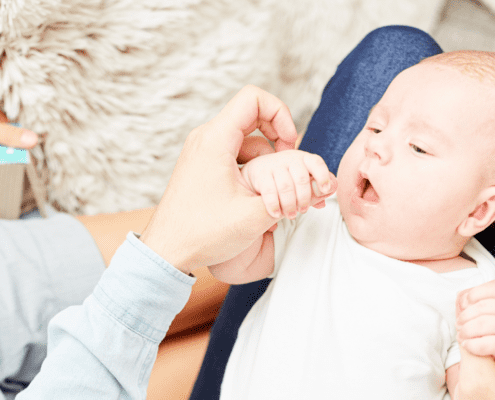
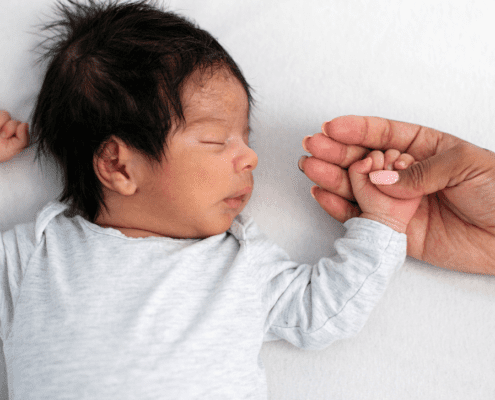
The Palmar Grasp reflex integrates during the first year after birth and is thought to be part of early evolutionary development that enables some mammals to cling or grasp on to their mother early in life. The hands and mouth both play a significant role in the baby’s earliest exploration of the world around her. When the inner pads of the fingers or palm are stimulated, fingers curl inward. Oftentimes you’ll see infants grasp tightly to an adult’s finger when placed in their outstretched palm. 

If the reflex remains active, it may impact fine motor skills, muscle tone development and may lead to speech and articulation challenges. Young children often demonstrate a lingering reflex by needing to clutch a beloved toy or object in their hand as they move through their day. A retained Palmer Grasp reflex may result in tightly clenched fists as well, placing tension on the body overall and particularly upward toward the TMJ area. The Palmer Reflex plays a role in the development of facial expressions in directly as well. 

Similar to Palmar Grasp, the Infant Plantar reflex involves curling inward of the toes, and may also demonstrate evidence of early evolutionary cling. This reflex calls upon the longest neurons in the body, traveling down from the brain to the feet and toes. The toes curl in response to pressure applied to the ball of the foot. The reflex gradually integrates with the development of more complex foot movements as an infant’s toes begin to dig into the ground and develop through early crawling stages. These movements prepare the body to stand upright, navigating the world with increasing stability, balance and coordination. 

When the Infant Plantar is retained, there may be challenges moving through stages of crawling to walking. Later in life, challenges with running, jumping and overall balance may occur. This may manifest in stiff legs and sore shins. Children that lead with ‘toe walking’ may also have active Plantar reflexes.

Studies have also shown the relationship between grasping reflexes and language, a concept we’ll explore in a later blog post. Infants open their mouths and babble as toes wiggle, and palms often open and close when the Sucking reflex is at work. Active grasping reflexes may result in delayed speech development as a direct connection.